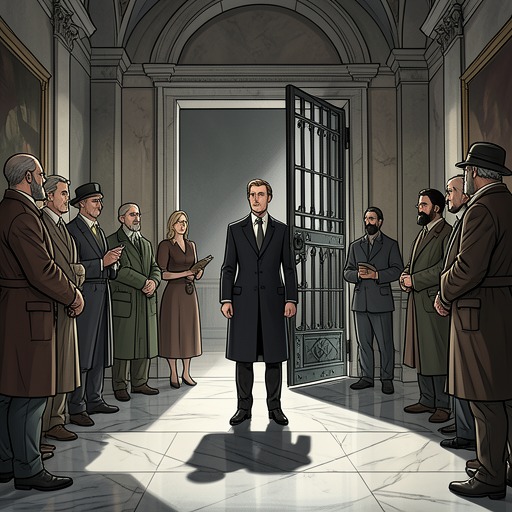
Murder of Prince Michael of Herzoslovakia
The Secret of ChimneysThe murder of Prince Michael of Herzoslovakia at Chimneys is the turning point that exposes the imposture behind the case: the woman living as Mademoiselle Brun was Queen Varaga, who shot the prince when he recognized her and then framed Herman Isaacstein. The revelation connects the immediate crime to the Herzoslovakian revolution, the missing diamond, and the murderers’ effort to evade recognition and prosecution.
Background and the disguise
Anthony Cade’s explanation begins with his early suspicion of the woman posing as Mademoiselle Brun. A light in her room on the night of the murder had first drawn his attention, but he later made inquiries in Brittany and accepted her identity after learning that the Comtesse de Breteuil had employed a governess by that name. He had not considered that the real Mademoiselle Brun might have been kidnapped en route to her new position and replaced by an impostor.
The question of recognition supplied a crucial clue. Cade initially shifted his suspicion to Mr Fish, but reconsidered after discovering that Fish was a Pinkerton’s agent pursuing King Victor. Virginia Revel had recognized the woman’s face, yet only after Cade mentioned her supposed connection to the Comtesse de Breteuil; Virginia had said that this explained why the face seemed familiar, not that she knew the woman’s identity. The distinction helped Cade understand why Virginia’s presence at Chimneys was dangerous to the impostor.
The murder and its political setting
Cade links the plot to a deliberate effort to keep Virginia away from Chimneys, which included arranging a dead body to obstruct her arrival. Although the Comrades of the Red Hand had killed that victim, apparently to punish supposed treachery, the staging of the crime and the absence of the group’s customary sign suggested that someone more capable was directing events. Cade suspected a connection to Herzoslovakia because Virginia was the only member of the house party who had been there.
The supposed Mademoiselle Brun could usually avoid contact with Prince Michael because a royal guest and a governess would not ordinarily meet. She had also been able to withdraw with a convenient migraine on the day the Baron visited. But while searching for the diamond, she unexpectedly came face to face with Prince Michael, who recognized her. Cade’s reconstruction identifies that recognition as the immediate trigger: exposure and disgrace threatened, she shot him.
The cover-up and the investigation
The murder was followed by deliberate efforts to redirect suspicion. Cade says that the woman placed the revolver in Isaacstein’s suitcase to confuse the trial and returned the letters. The planted weapon made Isaacstein appear implicated, linking the crime to the political and financial circle around George Lomax and the Herzoslovakian Loyalist party. When Battle later tells Isaacstein and Lomax that they are in serious trouble, his warning reflects how the murder investigation has put their dealings under scrutiny as well as exposing the killer’s attempt to frame Isaacstein.
The case’s wider investigation also turns on mistaken identities. At Dover, Cade and Fish discovered a mysterious stranger in captivity and understood the familiar pattern: the real person had been kidnapped, while an impostor took his place. Meanwhile, Battle had doubted his French colleague and wired to Paris for fingerprints and other identifying information. These parallel discoveries helped establish that disguises and substitutions, rather than a single isolated deception, shaped the investigation.
Revelation and significance
Cade’s account reveals that the woman was Queen Varaga, presumed dead after the revolution alongside the king. Her body had been recovered in a mutilated, unrecognizable state; Cade concludes that she had escaped, gone to America, and remained in hiding from the Comrades of the Red Hand. After King Victor was released, the two planned to recover the diamond together. The murder therefore joins the hidden survivor’s effort to reclaim the jewel to the old political violence that had driven her into concealment.
The murder’s solution reverses the investigation’s apparent direction. Prince Michael had initially seemed a possible impersonator, but that suspicion was mistaken: he was the person who recognized the disguised queen. The weapon planted in Isaacstein’s luggage likewise pointed toward a political suspect rather than the woman who had fired it. By bringing together the false governess, Virginia’s endangered recognition, the suppressed revolutionary history, and the diamond search, the explanation shows how the crime depended on controlling who could identify whom.